Hippo Housepower Report: Homeowners Gain Ground, Face New Challenges in 2026

Two adult homeowners rake leaves in front of their home with two children.

A home holds more than financial equity. It's where people mark milestones, make memories, and find safety. Each year, we survey U.S. homeowners to uncover where they're thriving and where they still need support. 

This year’s findings show the highest homeowner satisfaction rates in three years, but also a decline in preparedness and preventive maintenance. This can carry serious consequences; when homeowners neglect maintenance, their properties become more vulnerable to the unexpected.

Our Housepower Report builds on our annual series tracking the behaviors, spending habits, and preparedness of more than 1,600 U.S. homeowners. These efforts reveal key insights on repair costs, climate risks, the role of AI in insurance decisions, and more.

Key takeaways

  • In 2025, 56% of U.S. homeowners report no regrets about their home purchase—up from 27% in 2024. This could suggest growing satisfaction in homeownership despite ongoing responsibilities and costs.
  • Over a third (38%) are satisfied with the amount of home maintenance they completed in 2025, down from 44% in 2024.
  • In 2024, just over half of homeowners felt very prepared for extreme weather. By 2025, that number fell nearly 20 percentage points— underscoring the need for more emergency planning and supplemental coverage.
  • Nearly half expect to use AI tools, like ChatGPT or Google Gemini, to better understand their insurance policies, explore additional coverage options, compare providers, and more.

Homeowner regrets drop to lowest level in 3 years
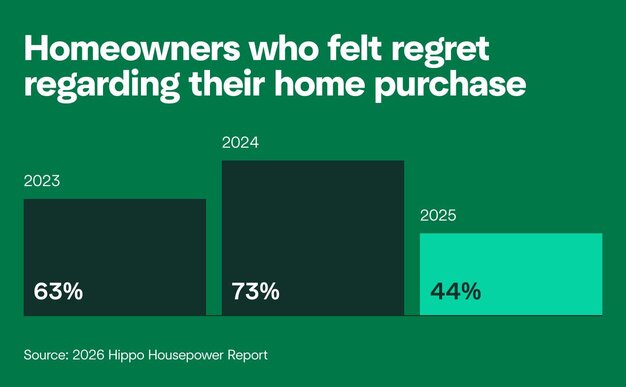
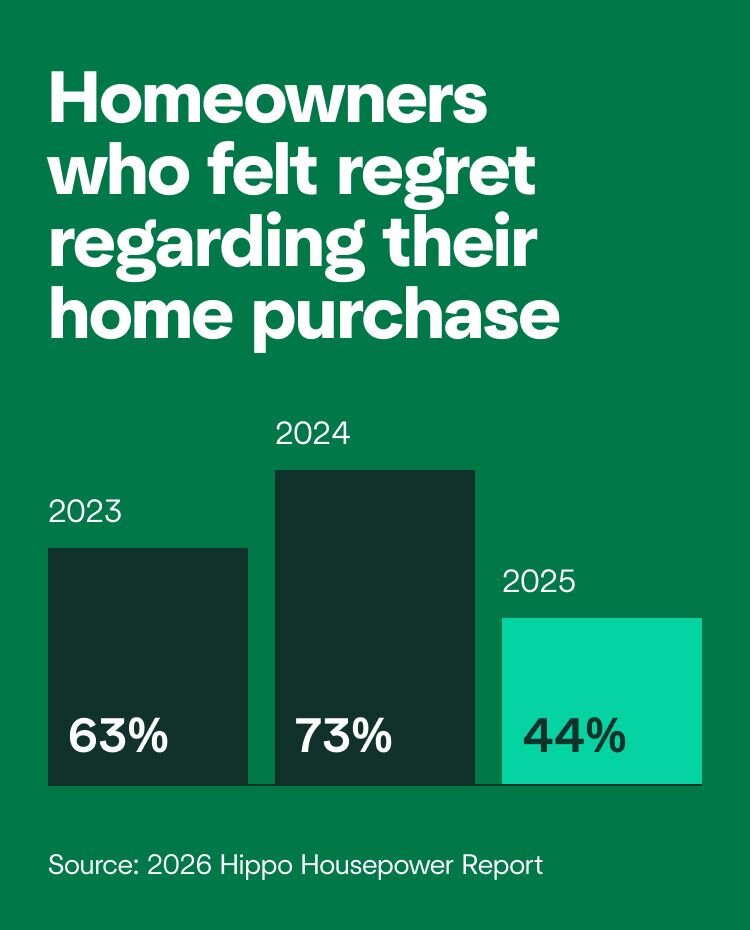
More than half of U.S. homeowners (56%) report no regrets about buying their home—a sharp rise from 27% in 2024. This coincides with fewer home-related problems year over year. 

In 2025, 70% of homeowners said they experienced no significant home-related issues, compared to 34% in 2024. Those who avoided major problems were even more content, with 71% reporting zero regrets. 
A bar graph showing homeowner regret data for 2023, 2024, and 2025.
Despite growing optimism, some homeowners still feel regretful about their home purchase. A closer look at the data reveals what's driving both lingering concerns and growing satisfaction rates.

Top 5 homeowner regrets year-over-year 

While satisfaction is rising, the pain points behind lingering regrets paints a more complete picture. 

Last year, pressures like high mortgage rates and compromising on the features they really wanted topped the list of disappointments. This year, roughly 1 in 6 homeowners report struggling with responsibilities, like seasonal maintenance, repairs, and upkeep.

Rank

2024 Regrets

2025 Regrets

#1

I had to compromise on features I really wanted.

Maintenance and upkeep require more effort than I planned for.

#2

I'm paying a mortgage rate that is higher than I can comfortably afford.

I’ve faced more unexpected issues than I anticipated.

#3

I’ve faced more unexpected issues than I anticipated.

Homeownership costs more than I thought it would.

#4

My home insurance premiums are higher than expected.

My home insurance premiums are higher than expected.

#5

Homeownership costs more than I thought it would.

I had to compromise on features I really wanted.

Several market trends could also help explain this change in sentiment:
  • Stabilizing mortgage rates: After peaking above 7%, mortgage rates fell to near three-year lows in 2025, hovering around 6.3%.1,2 Lower rates may fuel optimism and reduce financial strain for homeowners.
  • Rising inventory gives buyers options: Housing inventory climbed to 1.55 million active listings by late 2025, roughly 14% higher than a year earlier. This marks the strongest supply recovery since 2020. With more homes on the market, buyers have more negotiating power and face less pressure to compromise on features.3
  • DIY ambitions meeting reality: Regrets connected specifically to maintenance may be climbing because the majority of homeowners are taking on the work themselves. In 2024, 83% of homeowners said they would complete DIY maintenance tasks in 2025, with 55% doing “most home maintenance” without outside help. These homeowners may have found the workload more demanding than they expected.

Still, homeowner sentiment isn’t consistent across the U.S. Different regions face unique issues that shape how homeowners feel about their properties.

Regions where homeowners have the most regrets    

U.S. states in the South Central region experience some of the country's most extreme weather: Gulf Coast hurricanes, tornado activity, and increasingly intense flooding. Meanwhile, the Middle Atlantic faces high property taxes and steep living costs. 

However, despite the challenges, homeowners in these regions express the lowest levels of regret compared to all other U.S. states:  

Region

State breakdown

East South Central

64% of homeowners in Alabama, Kentucky, Mississippi, and Tennessee report no regrets on their home purchase.

Middle Atlantic

61% of homeowners in New Jersey, New York, and Pennsylvania report no regrets on their home purchase.

West South Central

59% of homeowners in Arkansas, Louisiana, Oklahoma, and Texas report no regrets on their home purchase.

Meanwhile, homeowners in the following states reported the highest levels of regret by region:

Region

State breakdown

Pacific

49% of homeowners in Alaska, California, Hawaii, Oregon, and Washington reported no regrets around their home purchase.

West North Central

54% of homeowners in Iowa, Kansas, Minnesota, Nebraska, North Dakota, South Dakota reported no regrets around their home purchase.

Mountain

54% of homeowners in Arizona, Colorado, Idaho, Montana, Nevada, New Mexico, Utah, Wyoming reported no regrets around their home purchase.

East North Central

54% of homeowners in Illinois, Indiana, Michigan, Ohio, Wisconsin reported no regrets around their home purchase.

While the intensity of homeowner regret varies geographically, recurring themes emerge nationwide. 

Maintenance, upkeep, and unexpected repairs remain the primary sources of concern, highlighting opportunities for homeowners to protect their investment through proactive planning and preparedness.

Appropriately, in six out of nine U.S. regions, replacing air filters was the most common maintenance done at home in 2025. In the rainy Pacific region, more people inspected gutters than any other maintenance task in 2025. New Englanders most commonly cleaned dryer exhaust vents and tested smoke and carbon monoxide detectors.

Boomers lead in satisfaction, millennials lead in regrets  

Our report shows that homeowner satisfaction is declining with younger generations. 

Baby Boomers report the highest satisfaction, with 71% expressing no regrets about their home purchase. This could result from decades of experience and more stable financial positions helping them to anticipate and manage the responsibilities of homeownership.

No regrets about their home purchase

Generations

71%

Baby Boomers (born 1946-1964)

55%

Generation X (born 1965-1980)

47%

Millennials (born 1981-1996)

49%

Generation Z (born 1997-2012)

Meanwhile, Generation X homeowners could face a unique mix of pressures and life events that contribute to higher levels of regret. These may include mid-career financial obligations (e.g., education costs for children, saving for retirement, etc.) combined with rising home costs and evolving family needs. 

Across all generations, maintenance and unexpected issues remain the most common sources of regret. This could indicate that, while experience and financial stability can improve confidence, the unpredictability of homeownership can affect anyone. 

Younger homeowners may feel these challenges more acutely, as they often have less experience navigating repairs and managing ongoing upkeep.

Proactive maintenance continues to be a top priority for homeowners
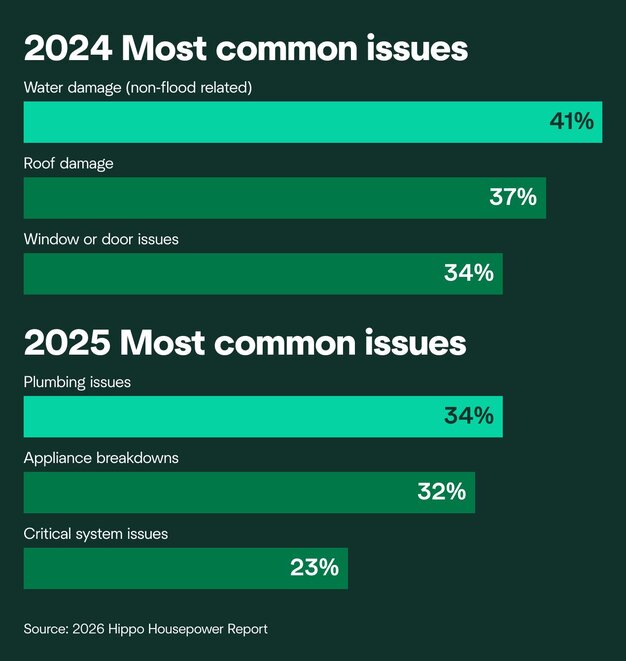
Homeowners are getting better at managing their home's needs, but the challenges they face are evolving.

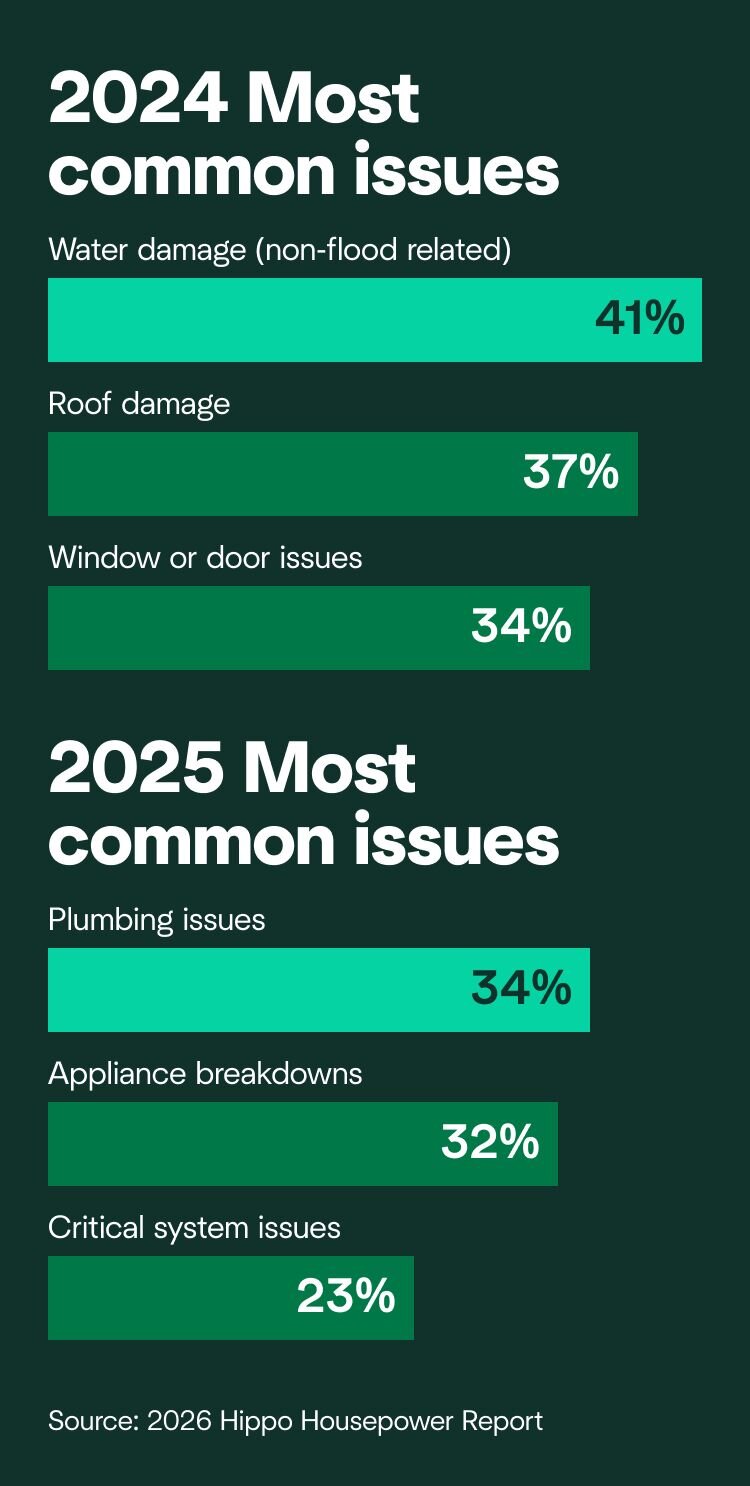
In 2024, the top issues were primarily exterior and weather-related; water damage and roof damage dominated the list. By 2025, the most common issues became interior and system-based. Plumbing issues, appliance breakdowns, and critical system failures took the top three spots.
A graph comparing the most common home issues reported by homeowners in 2024 vs. 2025.
We also observed a shift in why homeowners are completing maintenance tasks at all. While maintaining overall home condition remains the top priority, there's been a notable reordering of other motivations. 

Their top three reasons now include:
  • To protect the overall condition of their home (56%)
  • To prevent unexpected and costly damage (41%)
  • To achieve peace of mind and reduce stress (41%)

This marks a shift from last year, when protecting return on investment was the clear second priority at 46%—a motivation that has now fallen out of the top three entirely. While ROI remains important to homeowners, the rise of peace of mind as a priority alongside damage prevention suggests homeowners are increasingly balancing financial concerns with emotional wellbeing.

This pivot toward preventive, peace-of-mind maintenance may be paying off: homeowners who prioritize these tasks are experiencing fewer purchase-related regrets, likely the result of encountering fewer problems and managing less stress overall.

Homeowners’ biggest financial worries

Rising housing costs continue to squeeze U.S homeowners. According to the Federal Reserve Bank of Atlanta, a homebuyer today needs to earn $121,400 a year to afford a typical home. That’s nearly $40,000 more than what the average American earns.4 

These high costs are adding real pressure to homeowner budgets. 

According to our data, 76% of US homeowners reported that at least one home-related issue impacted their financial stability in 2025. These issues ranged from unexpected repairs and rising insurance premiums to utility bill fluctuations, major appliance replacements, increased property taxes or HOA fees, and costs related to home safety or security upgrades.

That financial strain may be forcing homeowners to cut back. Budgets for routine maintenance are shrinking: the share of homeowners in the lowest budget brackets ($500–$4,500) jumped from 39% to 58%, while those budgeting $6,501 or more dropped from 35% to just 14%.

Perhaps most concerning, the share of homeowners not budgeting at all doubled—rising from 9% to 18%.

Among the financial challenges affecting homeowners, unexpected home repairs or maintenance issues top the list—with 33% saying these costs impacted their financial stability. But the pain points vary by generation.

Here's a look at the top three financial concerns for each age group:

Rank

Gen Z

Millennials

Gen X

Baby Boomers

#1

Home safety or security (41%)

Utility bills (40%)

Utility bills (38%)

Utility bills (31%)

#2

Utility bills (35%)

Surprise repairs (34%)


Surprise repairs (36%)

Surprise repairs (30%)

#3

Surprise repairs (32%)

Major appliance replacement (30%)

Property taxes or HOA fees (27%)

Home insurance (29%)

Across every generation, utility bill fluctuations and unexpected repairs ranked among the top concerns. But the differences are telling, too. Gen Z homeowners are far more likely to feel the strain of safety and security upgrades, while Baby Boomers are keeping a closer eye on insurance premiums. 

These generational divides extend beyond finances into how each generation feels about homeownership and maintenance as well.

Younger homeowners feel more pride—but more pain—from home repairs

How homeowners approach maintenance varies significantly by generation. Gen Z leads in feeling pride from completing maintenance tasks (45%), followed by Millennials (39%), Gen X (35%), and Baby Boomers (31%). 

That mindset extends to skill-building: just over 40% of Gen Z said learning new maintenance skills increases their motivation, compared to only 17% of Baby Boomers. 

With online DIY tutorials and home maintenance walkthroughs more accessible than ever, younger homeowners have more opportunities than ever to learn new skills and tackle trending home projects.

But enthusiasm doesn't always prevent problems. A striking 85% of Boomers reported they did not experience any significant maintenance or repair issues that impacted their life in 2025. That number drops to 70% for Gen X, then falls more sharply to 59% for Millennials and 58% for Gen Z.

This pattern could reflect the benefit of life experience. Younger homeowners may still be learning what maintenance their homes need and when problems require immediate attention—and that unfamiliarity can lead to more issues arising, or make those issues feel more significant when they do.

AI becomes a new insurance advisor for consumers 

While homeownership feels more stable overall, financial challenges persist. A significant portion of homeowners (33%) report that unexpected repairs have impacted their financial stability, along with utility bill fluctuations (37%) and rising home insurance premiums or coverage changes (27%).

This reality can create a cycle where surprise costs make homeowners hesitant to purchase additional insurance options, even though certain add-ons could help protect them from the very issues they’re facing. 
And as their insurance decisions become more complex, many homeowners are turning to AI tools for help. 

Nearly half plan to use platforms like ChatGPT or Google Gemini to guide their coverage decisions:
  • 54% plan to use AI to check whether they’re paying a fair price
  • 48% plan to compare different insurance providers and policies
  • 48% plan to explore additional coverage options they should consider
  • 40% plan to use it to better understand their current policy

These habits indicate that homeowners want to make informed choices about their home protection planning. 

That said, while AI can be a helpful starting point for learning about insurance, it’s not a replacement for expert advice. Since AI tools can make mistakes or overlook policy details, it’s helpful to review coverage with a licensed professional before making any decisions.

Millennials and Gen Z face the toughest financial pressures in homeownership

A significant 67% of Boomers experienced at least one issue that impacted their financial stability in 2025. That number climbs as the age of homeowners decreases. 

Faced financial instability

Generation

67%

Baby Boomers (born 1946-1964)

77%

Generation X (born 1965-1980)

82%

Millennials (born 1981-1996)

85%

Generation Z (born 1997-2012)

Despite facing the most financial pressure, Gen Z is the most proactive group in purchasing additional insurance coverage. A notable 76% opted for an insurance rider compared to 68% of Millennials, 59% of Gen Xers, and 49% of Boomers. 

The reason why may come down to risk awareness—and some lingering uncertainty. According to our Disaster Preparedness Survey, 96% of homeowners ages 18–29 took steps to safeguard their homes from extreme weather. Despite these efforts, over one in five young homeowners still felt uncertain their home could withstand a disaster. 

That lingering uncertainty may explain why Generation Z was more likely to invest in additional coverage in 2025.

Homeowners add coverage riders—but many still misjudge their risk
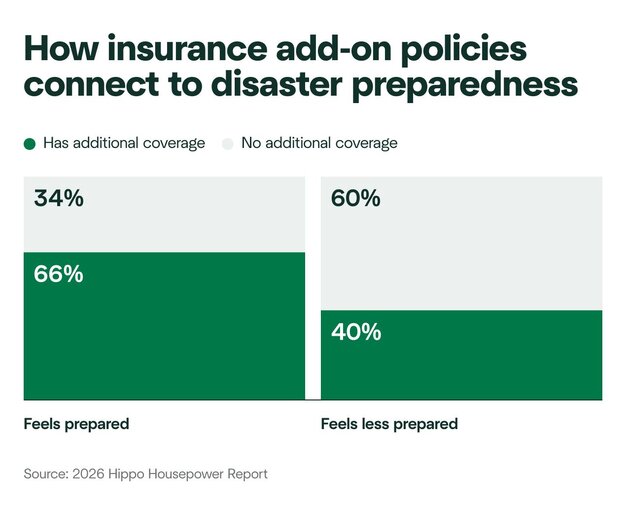
Our data also reveals a clear link between peace of mind and additional insurance coverage. 

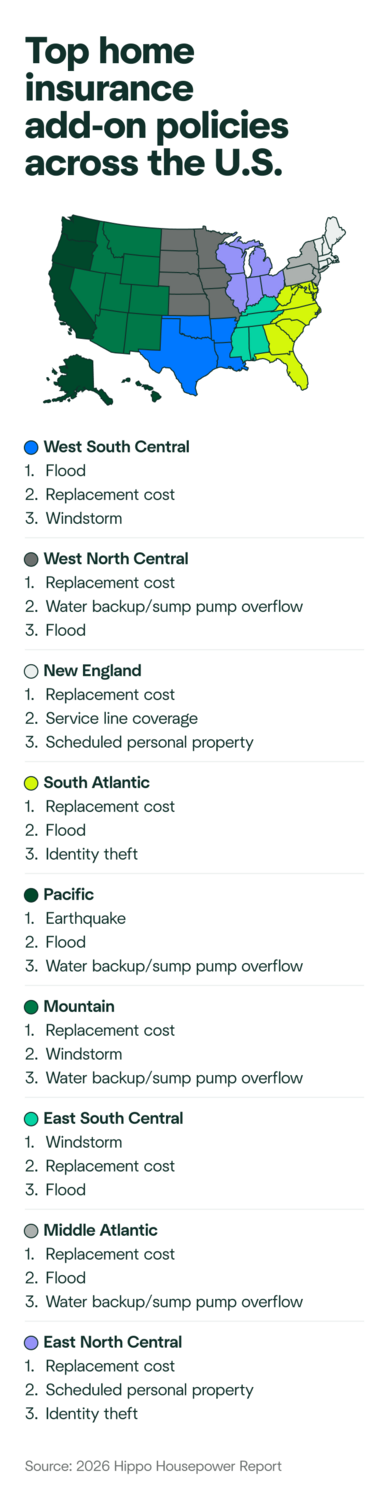
The majority of homeowners (60%) have purchased an insurance rider (add-on policy) to supplement their basic policy. The most common reason people buy these add-ons is straightforward: They want to feel safer in their homes and reduce out-of-pocket expenses. 

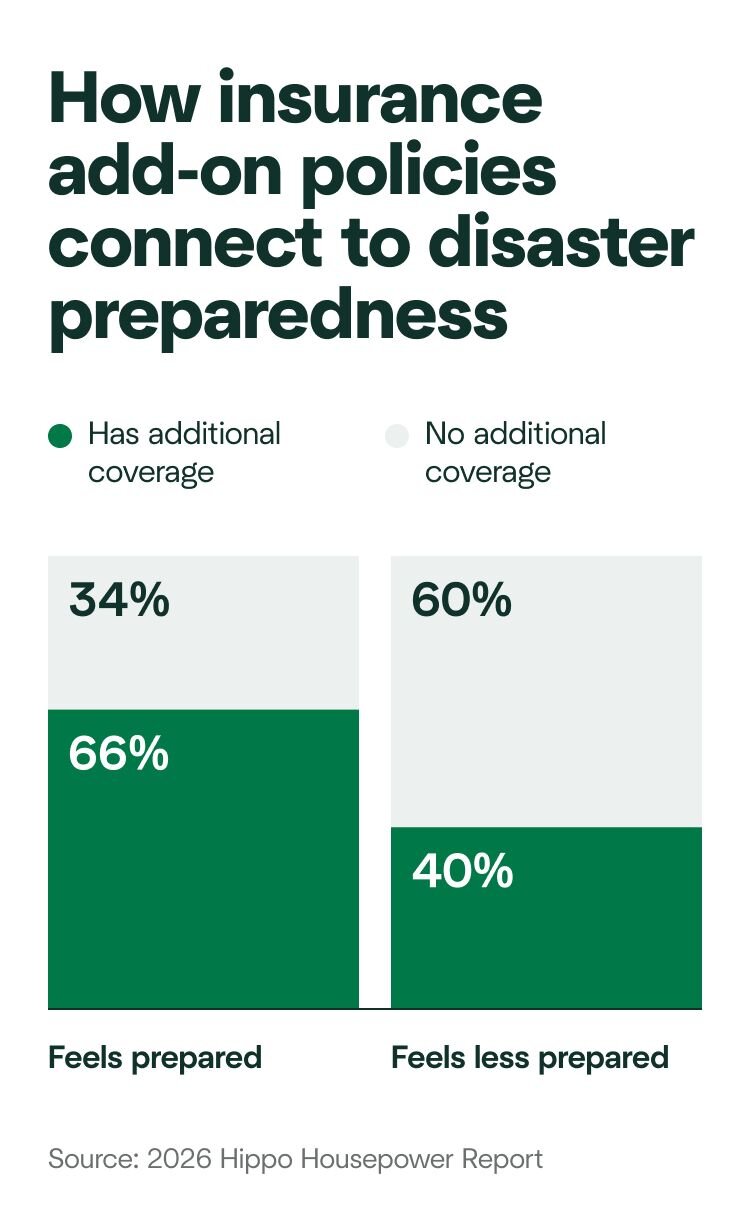
Of those who feel prepared for disasters, 66% have invested in that additional coverage. Replacement cost coverage leads as the most popular addition, followed by flood insurance and water backup or sump pump overflow protection.

But, among homeowners who feel less prepared for extreme weather, only 40% invested in additional insurance coverage.

This suggests that when homeowners know they're covered, they worry less.
A graph shows the correlation between those who have purchased an insurance rider and those who feel more prepared for extreme weather.
Among those without an insurance rider, 32% believed their current policy was sufficient. Another 23% found the cost too high. This is especially difficult when 27% of homeowners already cite rising insurance premiums as impacting their financial stability.

That said, standard policies may fall short for some homeowners depending on their home’s or region's unique risks. For example, standard policies often don't include flood coverage, which can leave homeowners in flood-prone areas without essential protection. 

Consulting with an insurance specialist could help clarify which riders are worth the investment.

Extreme weather causes homeowners to rethink preparedness nationwide

The climate is changing in ways homeowners can see and feel. More than a third (34%) have noticed an increase in heat waves, and over a quarter (27%) report more frequent strong winds or tornadoes in their area. 

These concerns represent real financial exposure. A September 2025 report from Realtor.com found that more than a quarter of all U.S. homes, representing $12.7 trillion in real estate value, face extreme hurricane, flood, or wildfire dangers that are often underestimated and underinsured.

Regional differences reveal gaps in extreme weather insurance coverage  

Homeowners in the Pacific region (Alaska, California, Hawaii, Oregon, Washington) lead the nation in extreme weather preparedness, with 70% having purchased an insurance rider. Given the region's exposure to earthquakes and coastal flooding, their top three add-on policies reflect local risks:

Pacific homeowners cite three main reasons for purchasing additional coverage:
  • 43% for peace of mind and reducing out-of-pocket risks 
  • 37% for covering extreme weather excluded from their base policy 
  • 33% because an insurance agent or provider recommended it 
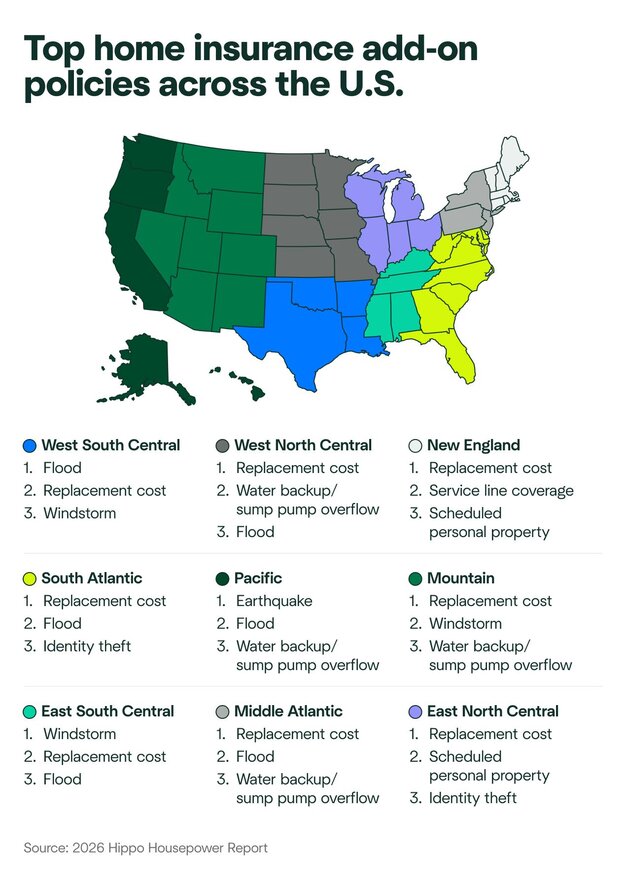
A map of the U.S.A. highlights the top three insurance riders purchased per region.
On the other hand, those in the Mountain region (Arizona, Colorado, Idaho, Montana, Nevada, New Mexico, Utah, Wyoming) are least likely to have an insurance rider, with 53% saying they’ve purchased one. 

That’s only a few points behind the Pacific region, but the gap pushed us to explore how Mountain Region homeowners plan to prepare for extreme weather in 2026. 

While one-third (33%) of these homeowners say they’ve reviewed or plan to review their coverage for 2026 extreme weather, only 15% say they’ve actually purchased (or plan to purchase) additional protection.

This shows that while many prioritize awareness, fewer homeowners are taking the next step to strengthen their protection. Wildfires, floods, and severe storms continue to pose real risks in this region—making both coverage and preparation essential.

Advice from current homeowners: Stay protected and prepared in 2026

Homeowner confidence is climbing, but vulnerabilities remain. The threats have simply evolved. Exterior weather damage has given way to aging interior systems, while extreme weather concerns continue to affect every corner of the country.

The homeowners navigating these challenges most successfully share two traits: a comprehensive home protection plan in place and a proactive maintenance mindset. They don't wait for problems to announce themselves. They anticipate, budget, and take steps to protect their domain.

When asked what advice they'd give to new buyers entering the market this year, here's what current homeowners recommend:

% who recommend

Advice from current homeowners

50%

Schedule and budget for regular, proactive home maintenance and emergencies

35%

Research financing options and ways to manage mortgage payments

35%

Invest in home upgrades that improve property value

32%

Make home upgrades to improve energy efficiency and sustainability

Looking to push your home protection efforts even further? Here are a few additional ways you can help safeguard your greatest investment:
  • Create an emergency fund specifically for home repairs. Only 32% of homeowners have done this, yet unexpected repairs impact the financial stability of one in three homeowners.
  • Review your insurance coverage annually. Standard policies don't cover everything. The homeowners who invest in additional coverage are the ones who feel most prepared.
  • Develop an emergency plan before you need it. Just 35% of homeowners have created or plan to create one. Knowing what to do when disaster strikes can reduce stress and potential damage.
  • Focus on system maintenance, not just cosmetic upkeep. Plumbing, appliances, and critical systems top the list of unexpected problems. Regular inspections can help catch small issues before they become expensive emergencies.
  • Consider energy efficiency upgrades. Current homeowners recommend this to new buyers for a reason. These improvements could support reduced utility costs while making homes more resilient to extreme temperatures.

For deeper insights into regional trends, generational patterns, and homeowner preparedness strategies, check out the complete Housepower Guide. 
Homeownership keeps changing, and your coverage should adapt to it. Stay ready for what’s ahead with insurance designed for modern risks. Contact a Hippo agent today to get started.

Methodology

The survey was completed on September 22, 2025, and conducted by Centiment on behalf of Hippo Insurance Services. The results are based on 1,619 completed surveys. In order to qualify, respondents were screened to be residents of the United States, over 18 years of age, and own a home. Data is census-balanced, and the margin of error is approximately ±2% for the overall sample with a 95% confidence level.

The MOE and confidence level for data filtered by specific demographics (subgroups) may differ from the overall result. Because these subgroups are naturally smaller than the total sample, they may have a larger margin of error than the ±2% for the full data set.

External sources 

This article is for informational purposes only. The content reflects general homeowner considerations and is not professional advice. It also includes observed trends within the surveyed population and certain additional information compiled from sources not affiliated with Hippo. While we believe this information to be reliable, we do not guarantee its accuracy or completeness. For any insurance-related decision, please consult your licensed insurance producer.
Sources cited are publicly available and referenced in October and November 2025.
A map of the U.S.A. highlights the top three insurance riders purchased per region.
A graph shows the correlation between those who have purchased an insurance rider and those who feel more prepared for extreme weather.
A graph comparing the most common home issues reported by homeowners in 2024 vs. 2025.
A bar graph showing homeowner regret data for 2023, 2024, and 2025.

Share

Any Questions?
Ask away - we're here to help
Email us

Hippo

Social Media

Get the App

app QR codeScan me

© 2026 Hippo Holdings Inc.

References to “Hippo” mean Hippo Analytics Inc. d/b/a “Hippo Insurance Services” which is an insurance agency licensed in 50 states (California Lic. No. 0K96532, Texas Lic. No.2213178) that is domiciled in Delaware and has a principal place of business in California. Hippo sells property and casualty lines of insurance for affiliated and non-affiliated insurance carriers and other underwriting entities (“insurers”). Hippo receives compensation from insurers in the form of a base commission that is normally based on a predetermined percentage of the premium. You may contact Hippo for more information about compensation expected to be received by Hippo. Nothing on this site alters the terms or conditions of any insurance policy. Coverage and coverage amounts selected are the decision of the buyer. Availability and qualification for coverage, terms, rates, and discounts are subject to the insurer’s underwriting criteria, and may not be available in all states. Please read your policy for a complete description of coverage.