First-time homeownership: How to plan smart from day one
The keys are yours. Now comes the part no one warns you about: actually taking care of your new home. Hippo’s 2026 Housepower Report shows that homeowners commonly spend several thousand dollars each year on maintenance and repairs. A little planning now can go a long way.
Your dishwasher breaking or AC going out will still be inconvenient. But with some preparation, surprises can be manageable.
Key takeaways
- 92% of homeowners paid out of pocket for unexpected repairs in 2025.
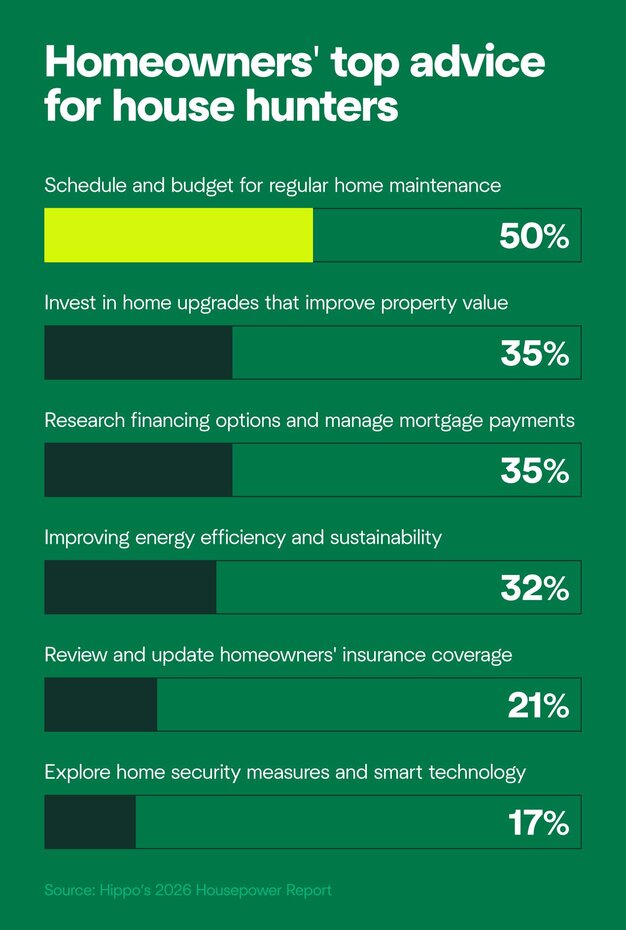
- 50% of homeowners would advise anyone looking to purchase a home to schedule and budget for regular, proactive home maintenance and emergencies.
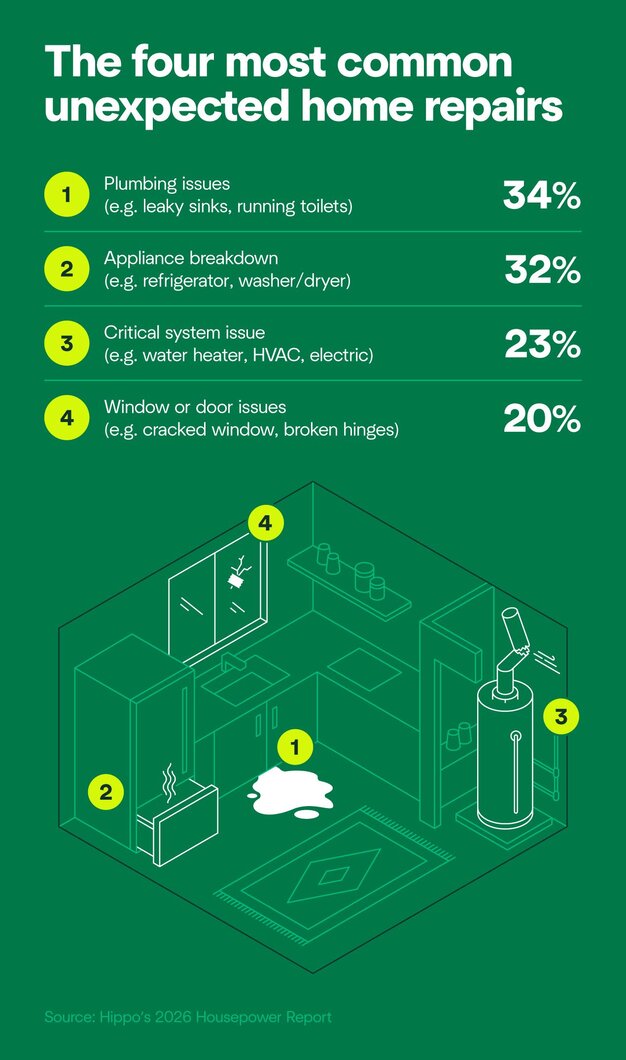
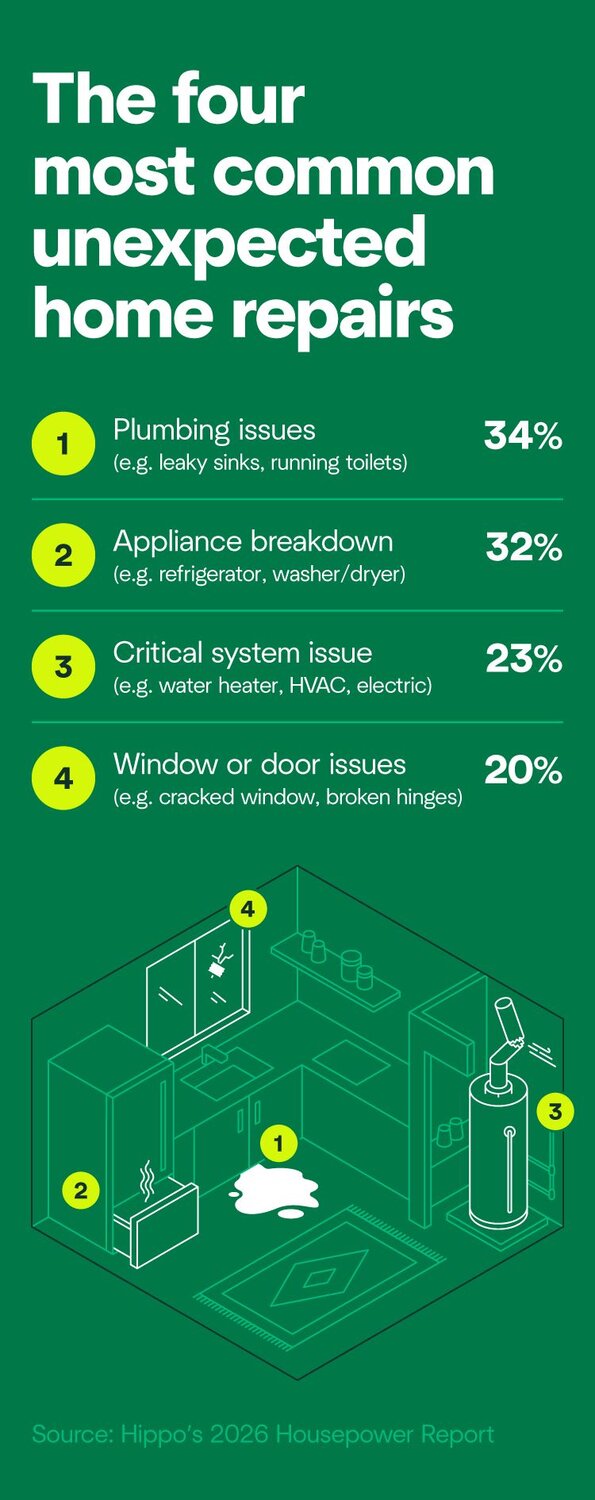
- New data shows that unexpected maintenance is common—which may surprise new homeowners. In fact, 32% of homeowners experienced an appliance breakdown in 2025. That includes things like plumbing (34%) or critical system issues (23%).
- 34% of homeowners spent more than their planned home maintenance budget in 2025, emphasizing the need for regular maintenance and, if possible, a maintenance fund.
- 42% of homeowners bought an insurance rider (also called an add-on policy) to feel more secure and reduce out-of-pocket costs. That peace of mind can be especially valuable for first-time homeowners.
Almost no homeowners escape unplanned repair costs
Home repairs aren't a matter of if—they're a matter of when. The vast majority (92%) of homeowners spent money out of pocket on unexpected home repairs in 2025. The most common repairs included plumbing (34%), appliances like refrigerators and washers (32%), and critical home systems, like their HVAC or water heater (23%).
Not every repair is a major expense. The cost to fix plumbing, appliances, HVAC systems, and other important systems can vary widely depending on where you live, what needs fixing, what repair needs to be done, and whether something needs to be replaced entirely.
Roof and foundation repairs tend to be the most expensive home repairs and can easily cost tens of thousands of dollars for a full replacement. But calling a plumber for a leaky pipe or ordering a replacement part for your HVAC unit may cost as little as $100.
All in all, one-third (36%) of homeowners spent $3,000 or more on these unplanned repairs in 2025. If you're a new homeowner, there's no guarantee you'll pay that much—most commonly, 27% spent $1,000 or less—but it still may be wise to plan to spend more than you expect. Around 1 in 3 (34%) homeowners went over their planned home maintenance budget in 2025.
How new homeowners can save for repairs
As a rule of thumb, consider saving at least 1% of your home's value each year for maintenance and repairs. If you own a $300,000 home, that's $3,000 a year. But with 36% of homeowners spending more than $3,000 in 2025, the 1% benchmark is a helpful starting point.
There are a few factors to consider when planning how much to save for home repairs:
- Is your home older? Younger homeowners tend to buy newer houses: 36% of Gen Z homeowners (ages 18-28) own a new or custom-built home, compared to only 24% of baby boomers (ages 61-79). They're less likely to deal with problems that come with an older home, like rusty iron pipes or a sagging roof.
- Is your home newer? You may think you have fewer problems to worry about in a new home, but ask for a detailed inspection report anyway, so you understand your home's condition inside and out.
- Do you know your home needs repairs? Prioritize the list of repairs based on the extent of the damage and the most important parts of the home. Consider prioritizing badly damaged or vital features of your house (think your HVAC unit, electricity, plumbing, foundation, or roof) first.
- Do you think your home will need repairs later? On the other hand, if you learned during inspection that you'll need to replace your roof or pipes in two or three years, you can start saving for that now. Ask around for several price estimates and use a rough average of those quotes as your savings goal.
40% of homeowners now turn to AI to decode their insurance policy
AI tools can be a helpful resource for people who want to understand their insurance policy better. Two in 5 homeowners (40%) at least sometimes use AI tools to understand their home insurance policy. Try asking:
- I am buying my first home. In simple terms, what are the main things a standard home insurance policy protects? Does it cover the house itself, my stuff inside, and what happens if someone gets hurt on my property? Please cite your sources.
- I am a homeowner in [city/state]. My home was built in [year]. Based on my location and home age, what are the most common insurance riders I should consider to cover gaps that a standard policy may exclude? Please cite your sources.
AI is a helpful starting point, but it isn't a substitute for expert advice. Before making any policy decisions, speak with a licensed insurance agent, especially if you want to make any changes or don't understand your policy terms. Your insurer could help you explore home upgrades that could save you money on your insurance premium, like a new roof or better security system.
Whether you use AI or not, your homeowners insurance policy is worth reading carefully. Knowing what’s included in your policy, and what isn’t, can save you from surprises when you need it most. Start by reading your homeowners insurance policy cover to cover. You'll want to understand two main elements of your policy: property coverage and liability coverage.
In your property coverage, make sure you carefully review how your policy will cover your:
- Dwelling: Your home
- Other structures: Any detached buildings, typically a garage or shed
- Personal contents: Your belongings, but pay careful attention to the coverage limits. Your insurance likely only covers up to a certain amount for the total value of your jewelry, electronics, or other valuables.
- Loss of use: Living expenses in the event your home is uninhabitable due to damages
Your liability coverage, on the other hand, will typically cover personal liability, in case someone is injured on your property or damages something, and medical payments to others.
Some things, like flooding damage or valuable personal contents, may not be covered. You can cover some hazards or valuables with insurance riders for an additional cost. Replacement cost riders, which pay for personal items not covered by insurance, are particularly popular. Nearly 1 in 4 (23%) homeowners have them.
Current homeowners: budget before you need to
When asked what advice they'd give someone looking for a home, half of current homeowners said they should schedule and budget for regular, proactive home maintenance and emergencies.
If you haven't already done preventive maintenance as a new homeowner, it's never too late to begin. These tips can help get you started.
Save for repairs and maintenance
If it's within your means, consider opening a separate savings account and directing a portion of your paycheck there each month for home-related expenses. If you have an existing savings account, you can also see if your bank allows you to designate a portion of your savings for specific purchases or goals.1
Saving a few extra hundred dollars a month isn't easy for many households.2 But even a small, consistent amount can add up, and you'll thank yourself if you end up needing it.
Keeping up with regular home maintenance can also help you avoid needing more expensive repairs down the line. If you're not sure how to get started, the Hippo Home app offers free resources to help you make a personalized plan.
Check out local first-time homebuyer services
If you need a complete walk-through on everything from saving for a down payment to fixing a leaky sink, consider looking up your local housing counseling agency affiliated with the U.S. Department of Housing and Urban Development. These agencies can provide expert advice and will let you know about first-time homeowners programs near you.
Check your city's homeowners' resources, too. For example, New York offers one-on-one homeownership counseling and online education courses.
Your bank, credit union, and insurance provider are also good starting points for questions about your mortgage or home insurance. Fannie Mae, a federally sponsored mortgage financier, also offers a free homeownership course covering mortgages, budgeting, and maintaining your home's value.
Feel confident as a homeowner, whether this is your first—or fifth—home
Homeownership comes with a learning curve, but you don't have to go it alone. Hippo Insurance Services is here to help you find the top home insurance options based on your needs. Our guides cover everything you need to know as a homeowner, from costly maintenance mistakes to what to expect in your first year.
Methodology
Any data referencing the 2026 Housepower Survey was collected on September 22, 2025, and conducted by Centiment on behalf of Hippo Insurance Services. The results are based on 1,619 completed surveys. In order to qualify, respondents were screened to be residents of the United States, over 18 years of age, and homeowners. Data is census-balanced, and the margin of error is approximately ±2% for the overall sample with a 95% confidence level.
The MOE and confidence level for data filtered by specific demographics (subgroups) may differ from the overall result. Because these subgroups are naturally smaller than the total sample, they may have a larger margin of error than the ±2% for the full data set.
External sources
- NerdWallet. (2026) The Average Home Insurance Cost in the U.S. for 2026
- Bankrate. (2025) Median home prices in every state
This article is for informational purposes only. The content reflects general homeowner considerations and is not professional advice. It also includes observed trends within the surveyed population and certain additional information compiled from sources not affiliated with Hippo. While we believe this information to be reliable, we do not guarantee its accuracy or completeness. For any insurance-related decision, please consult your licensed insurance producer.
Sources cited are publicly available and referenced in April 2026.
Related articles

Hippo Housepower Report: Homeowners Gain Ground, Face New Challenges in 2026
5 Things First-Time Homeowners Find Out During Their First Winter

5 Costly New Homeowner Maintenance Mistakes (and How to Fix Them)

When Is the Best Time To Buy a House? Expert Tips for Homebuyers

Multigenerational Homes: How Families Are Hacking the Housing Market