Hippo Insurance Ratings Explained: AM Best, BBB & Customer Reviews

Hippo Insurance Ratings Explained: AM Best, BBB & Customer Reviews
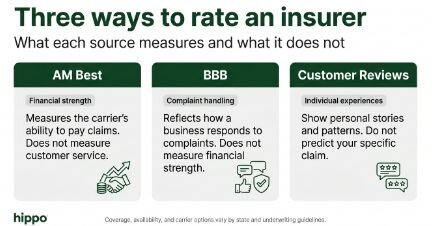
Hippo Insurance ratings depend on the source: AM Best measures financial strength, the BBB reflects complaint-handling and business practices, and customer reviews show individual service experiences. Use all three, then confirm the underwriting carrier on your quote, because the carrier’s financial rating is the clearest signal of claim-paying capacity. The sections below explain what each rating measures, how to look it up, and what to check besides ratings before you buy.
What “Hippo Insurance ratings” actually means
When people search for Hippo Insurance ratings, they are usually looking at three different things that often get lumped together: agency ratings, business-bureau grades, and customer reviews. Each one answers a separate question. Agency ratings such as AM Best look at whether the company has the financial resources to pay claims. A Better Business Bureau grade looks at how a business handles complaints and operates day to day. Customer reviews on platforms like Google or Trustpilot capture individual experiences, which can be helpful but tend to skew toward people who felt strongly one way or the other.
There is one more distinction that matters more than most shoppers realize: the difference between the Hippo brand and the underwriting carrier. Hippo operates as a technology-forward home insurance brand, but the actual policy on your home may be underwritten by a separate insurance company. That carrier is the legal entity responsible for paying your claim, and it is the entity whose financial-strength rating you should verify. When you read a rating online, always ask which entity it applies to, because a review of the Hippo customer experience is not the same as a financial-strength rating of the carrier behind your specific policy.
Quick answer: how to evaluate Hippo’s ratings in 60 seconds
If you only have a minute, check three things in order. First, find the underwriting carrier named on your quote or declarations page and look up its AM Best financial-strength rating. Second, look at the BBB profile for the correct Hippo legal entity to see the grade, accreditation status, and the themes in recent complaints. Third, skim recent customer reviews across a couple of platforms and look for patterns rather than single dramatic stories. Ratings are a screening tool, not a guarantee, so treat them as one input alongside coverage, deductibles, and price.
AM Best rating for Hippo (financial strength)
AM Best is a credit-rating agency that specializes in the insurance industry, and its financial-strength rating estimates a company’s ability to meet its ongoing policy and claim obligations. In plain terms, it is a measure of whether the insurer is likely to have the money to pay claims when many policyholders need it at once, such as after a regional storm. AM Best does not measure how friendly the customer service is or how fast an app loads; it focuses on balance sheets, operating performance, and risk management.
AM Best grades run on a familiar letter scale, with categories like A++ and A+ at the superior level, A and A- at the excellent level, and B++ and B+ in the good range, continuing downward from there. For homeowners insurance, many shoppers look for a carrier in the A range or higher, though the right threshold depends on your risk tolerance and the rest of the policy. The key habit is to read the grade for the specific underwriting carrier on your policy rather than assuming a single rating applies to every product sold under a brand.
To find the AM Best rating for your policy, locate the carrier’s legal name on your quote or declarations page, then search AM Best’s company listing for that exact entity. If a rating is not listed, that does not automatically mean the carrier is weak; some companies are rated by other agencies, and newer or specialty carriers may carry different forms of assessment. When a rating is missing, the responsible move is to verify the carrier through your state Department of Insurance and ask the agent directly rather than guessing.
BBB rating for Hippo Insurance (complaints and responsiveness)
The Better Business Bureau assigns letter grades that reflect how a business interacts with customers, especially how it handles and responds to complaints. A BBB grade can factor in complaint volume relative to size, whether the company responds to complaints, time in business, and transparency about practices. It is useful as a signal of responsiveness and business conduct, but it is not a measure of financial strength and should not be read as one.
When you look up Hippo on the BBB, capture three things: the letter grade, whether the entity is BBB accredited, and the recurring themes in recent complaints. Make sure you are reading the profile for the correct Hippo legal entity, because large brands can have more than one related profile. Common complaint themes across the home insurance industry include claim delays, disputes over the value of a covered loss, communication gaps during a claim, and confusion at renewal. Seeing a theme is more informative than seeing one angry review.
Use BBB data responsibly. Complaint counts tend to rise with company size, so a larger insurer may show more total complaints simply because it has more policyholders. Look at how the company responded and whether complaints were resolved, not just the raw number. Treat the BBB grade as one lens on customer experience, then balance it against financial-strength ratings and the actual coverage you are buying.
Hippo Insurance customer reviews: what people tend to say
Customer reviews come from many places, including Google, Trustpilot, WalletHub, and app-store ratings, and each platform attracts a slightly different audience. Reviews measure individual experiences and emotions in the moment, which makes them valuable for spotting patterns but unreliable as a single source of truth. The most useful thing reviews can tell you is what tends to go well and what tends to go wrong, not whether a company will pay your specific claim.
Common positive themes for digital-first home insurers often include a fast quote process, an easy-to-use app, helpful smart-home perks, and responsive sales support. Common negative themes across the industry tend to cluster around claim timelines, disagreements over payout amounts, premium increases at renewal, and difficulty reaching a specific person during a complex claim. None of these themes are unique to one company, which is exactly why reading them as patterns is more honest than treating any single review as the verdict.
To read reviews like an expert, weight recent reviews more heavily than old ones, separate sales experiences from claims experiences, and ignore both the five-star raves and the one-star meltdowns until you see whether the same issue repeats. A claim-time review from last quarter tells you more than a glowing quote-time review from three years ago. Patterns, recency, and the claims-versus-sales distinction are the three filters that turn a messy review page into useful information.
Why Hippo ratings can look different across sources
Ratings disagree because they measure different things over different time windows using different methods. A financial-strength rating is a slow-moving, analyst-driven assessment, while a customer review is a fast-moving snapshot of one person’s day. It is entirely normal for a company to hold a solid financial rating while also showing mixed reviews, because being financially sound and being easy to deal with on a specific claim are not the same quality.
Selection bias also shapes what you see. People who are motivated to leave reviews are often those who had an unusually good or unusually bad experience, so review averages can look more polarized than the typical experience. Finally, entity mix-ups create confusion: a review aimed at the brand’s app may sit next to a complaint about a carrier’s claim decision, even though those involve different parts of the business. Keeping the entity straight is the single best way to avoid drawing the wrong conclusion from conflicting numbers.
What to check besides ratings before buying Hippo home insurance
Ratings get you to a shortlist, but the policy details decide whether the coverage actually fits. Start with the coverage amounts: dwelling coverage for the structure, personal property coverage for your belongings, and loss of use coverage for living expenses if a covered loss makes your home uninhabitable. A high rating means little if the limits are set too low for your home’s rebuild cost.
Next, look closely at deductibles, including any separate wind or hail percentage deductibles that apply in storm-prone areas, since those can change your out-of-pocket cost dramatically after a major event. Then review exclusions and available endorsements such as water backup coverage, roof settlement terms, and ordinance or law coverage, because what is excluded often matters more than what is included. Finally, understand the claims process and the renewal picture: how you file, what documentation is expected, and how rate changes or eligibility shifts could affect you a year from now.
Is Hippo Insurance legit? A practical decision checklist
Hippo can be a good fit when the price and coverage match your needs, but ratings vary by source and may not reflect the exact underwriting carrier behind your policy. Treat the following as a quick screening checklist: confirm the underwriting carrier on your quote, look up that carrier’s AM Best financial-strength rating, check the BBB grade and complaint themes for the correct entity, skim recent reviews for repeating patterns, compare coverage limits and deductibles against your home, and read the exclusions before you commit.
Hippo may be a strong option for homeowners who value a fast digital quote, smart-home features, and a modern app experience, and who confirm that the underlying carrier and coverage fit their situation. It may be worth considering alternatives when the carrier’s rating or availability does not match your needs, when the coverage gaps are larger than you are comfortable with, or when an apples-to-apples comparison shows another insurer offering better value for the same protection. The point is not a simple verdict; it is a repeatable way to decide for your own home.
Frequently asked questions
What is a good AM Best rating for home insurance? Many homeowners look for an underwriting carrier rated in the A range or higher, since that signals a strong ability to pay claims. The right threshold depends on your risk tolerance and the rest of the policy, so use the rating as a screen rather than a finish line.
Why do some insurers not have an AM Best rating? Some carriers are rated by other agencies, and newer or specialty companies may carry different forms of assessment. A missing AM Best rating is not proof of weakness; verify the carrier through your state Department of Insurance and ask the agent for clarity.
Does a BBB rating mean an insurer is financially strong? No. A BBB grade reflects complaint handling and business practices, not the balance sheet. For financial strength, look to an agency like AM Best and read the rating for the specific underwriting carrier on your policy.
Are Hippo Insurance reviews trustworthy? Reviews are useful for spotting patterns but skew toward strong experiences, so read them in aggregate. Weight recent reviews, separate sales from claims feedback, and look for repeating themes rather than relying on any single review.
How can I verify the insurer behind my Hippo policy? Find the carrier’s legal name on your quote or declarations page, then look it up on AM Best and your state Department of Insurance. That confirms which company is responsible for paying claims and lets you check its financial-strength rating directly.
The bottom line on Hippo ratings
Hippo Insurance ratings are most useful when you read them as three separate signals: AM Best for financial strength, the BBB for complaint handling, and customer reviews for everyday experience. No single number tells the whole story, and the most reliable check is to confirm the underwriting carrier on your own quote and look up its financial-strength rating. Combine that with a careful read of coverage, deductibles, and exclusions, and you will have a far clearer picture than any star rating can give you on its own.
A practical next step is to compare quotes from Hippo and two or three competitors using the same coverage limits, then verify the underwriting carrier and its AM Best rating before you purchase. You can start a homeowners insurance quote with Hippo to see your options.
Coverage, availability, and carrier options vary by state and underwriting guidelines.
Related articles

Hippo Housepower Report: Homeowners Gain Ground, Face New Challenges in 2026

Is Your Fixer-Upper a Mistake? 1 in 5 U.S. Homeowners Said Yes

The insurance coverage gap: 40% of homeowners are opting out of additional protection

Hippo's 2026 Homeowner Anxiety Report

Maintenance Checklists for New Homeowners