Homeowner anxiety report: Balancing the stress and rewards of homeownership
From mortgage costs to keeping up with maintenance, homeownership comes with real pressure. A new Hippo survey of more than 1,000 homeowners shows just how widespread that pressure is — and what's driving it. The good news: 97% say it's still worth it.
Key takeaways
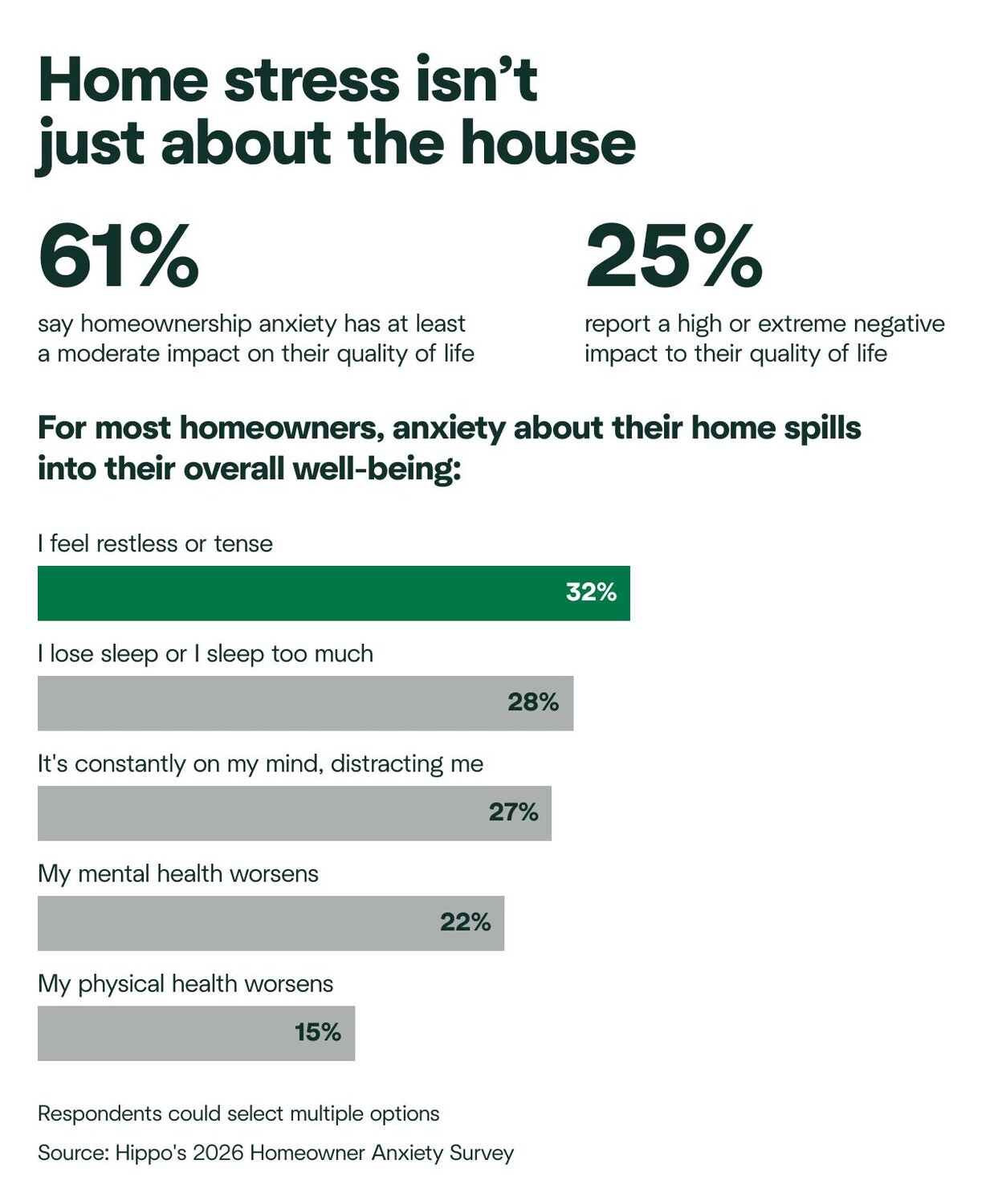
- A quarter of homeowners (25%) say homeownership-related anxieties make a negative or extremely negative impact on their quality of life.
- This is even more apparent in Gen Z and millennials, where 76% say homeownership-related anxiety has a negative impact on their quality of life, compared to only 51% of Boomers and Generation X homeowners.
- 69% of homeowners currently have unfinished maintenance or repair tasks they're putting off. This can significantly impact stress. One in four (25%) say maintenance needs significantly contribute to their stress, and 13% say it's their single biggest source of stress as a homeowner.
- Nearly half (45%) of those with deferred tasks estimate the backlog could cost $5,000 or more to complete everything on their list, and 15% estimate it would take $20,000 or more.
- Despite the stress, 97% of homeowners say owning their own home is worth it. When asked what makes it worthwhile, owners pointed most often to providing stability for their family, followed by the pride of personal achievement, building equity and wealth, and the freedom to customize their space.
Homeownership stress is real — and it's affecting quality of life
Nearly 1 in 5 (18%) homeowners say their home or homeownership responsibilities are one of their top sources of stress — on par with the share who cited their career or their relationship as a top stressor.
For many, that stress has a direct quality-of-life impact: 35% say homeownership anxiety has a moderate impact on their quality of life, while 25% say the impact is very or extremely negative.
As a result of this stress, homeowners say they feel restless, they're losing sleep, or their health is worsening.
Homeowners today are navigating an economy where the cost of essential goods and services is rising faster than earnings, on top of already high housing prices.1,2
If you're already stretched thin, an unexpected repair like a burst pipe can put real pressure on your finances — and your peace of mind.
Younger homeowners are nearly twice as likely to feel the impact
More than three-quarters (76%) of Gen Z and millennial homeowners feel moderately to extremely impacted by homeownership anxieties, compared to 51% of Gen X and baby boomer homeowners.
Younger homeowners are also more likely than older homeowners to say their stress or anxiety shows up physically — affecting sleep, restlessness, and overall mental and physical health.
It’s easy to see why. Many younger homeowners are entering the market at a uniquely challenging time: navigating high interest rates, high mortgage prices, and stagnant wages. The median age of first-time homebuyers has reached 40 years old, which is the highest on record.3
Nearly half (43%) of millennials and 38% of Gen Zers say their finances are one of their biggest stressors. And for those who do make it to homeownership, the pressure doesn't let up — it just changes shape.
Most homeowners are sitting on deferred maintenance — and it's adding up
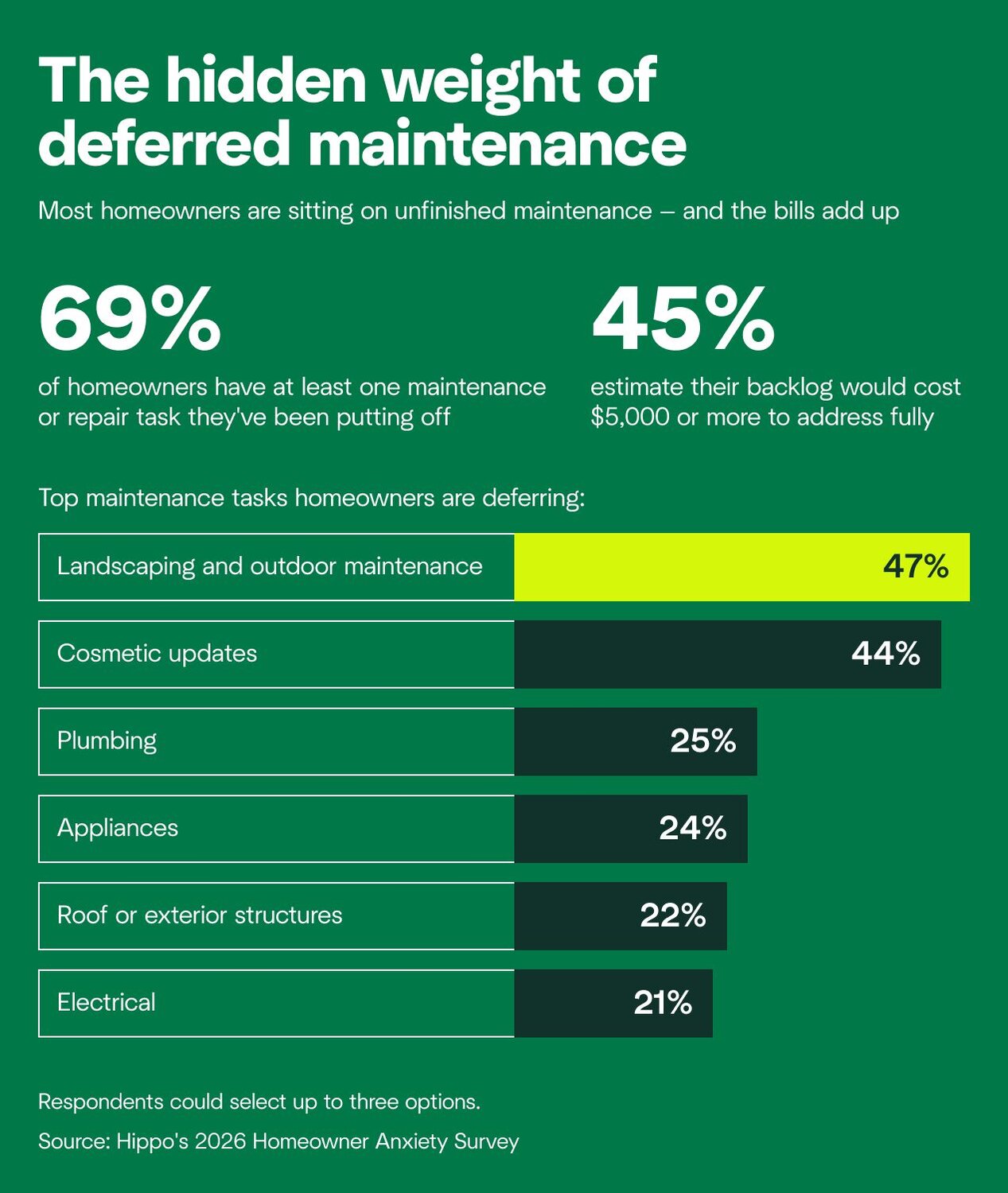
Nearly half (49%) of homeowners say their home is their most valuable financial asset and they depend on it for long-term security. However, 69% of homeowners currently have unfinished maintenance tasks. Only 16% of homeowners say they rarely, if ever, put off maintenance or repairs.
Among the deferred maintenance tasks are plumbing work (25%), roof or foundation repairs (22%), and electrical work (21%) — repairs tied to some of a home’s most essential systems and often among the more expensive to address.
Looking at deferred maintenance overall, nearly half (45%) of homeowners estimate they’d need $5,000 or more to get caught up on these tasks, while 15% say it would take $20,000 or more.
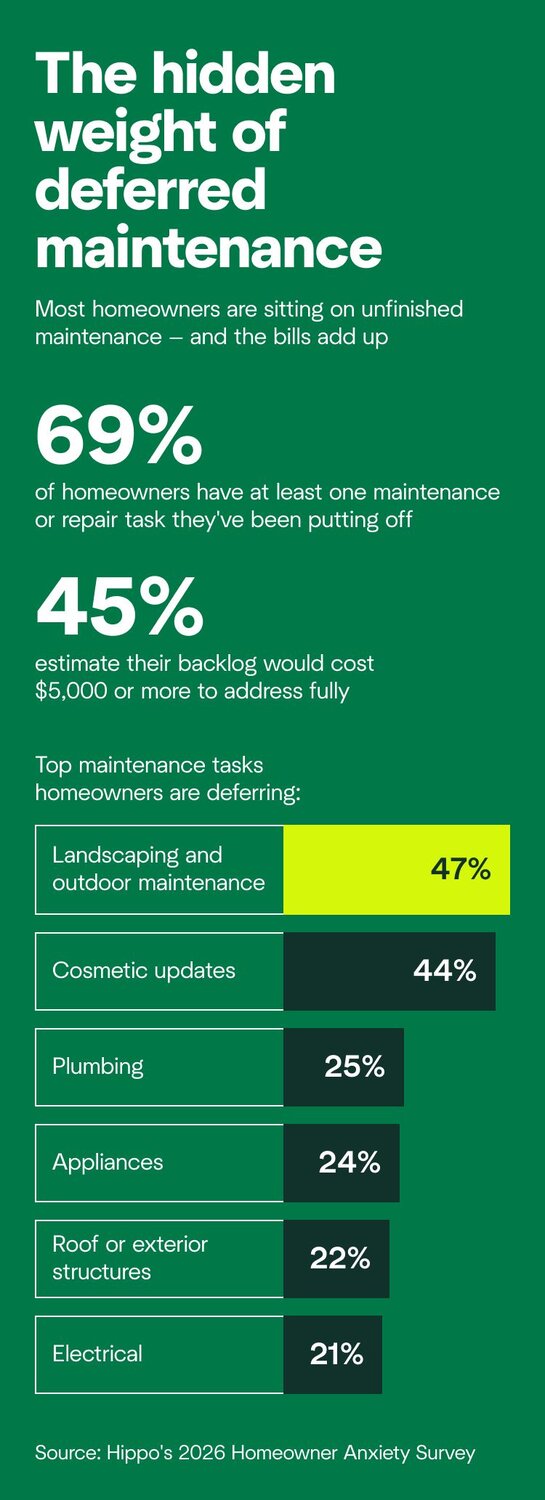
This, too, can be a major stressor for homeowners. More than 1 in 3 (38%) homeowners say the state of their home's maintenance and repair needs is either their single biggest source of stress or it's an overall significant contributor to their stress.
Minor home repairs can become major expenses if left unaddressed
Major home repairs can cost as much as $30,000 or more for a roof, $5,000 or more for plumbing, and $6,000 or more for electrical systems.
It's normal to feel overwhelmed by expensive home repairs, especially if you're struggling to pay for them. By scheduling regular maintenance and taking care of smaller damages now, you may avoid needing to make a major repair later.
Resources like our home maintenance checklist, and the Hippo Home app, can guide you through each step you need to take year-round. At a minimum, plan for yearly inspections or maintenance on your home’s core systems: your roof, foundation, plumbing (including your water heater), and HVAC.
If you have them, also consider inspecting these systems yearly for damage, worn parts, or to see if they need cleaning:
- Sump pumps
- Fireplaces
- Chimneys
- Radiators
- Garage doors
- Home security systems and locks
Despite the stressors, 97% of homeowners believe ownership is still worth it overall
Nearly half (47%) of homeowners turn to friends or family when they're feeling stressed. Others have adopted a personal wellness practice, like exercise or meditation (33%), or sought help from a mental health provider (18%) or medical doctor (19%).
Everyone deals with stress differently, but nearly one-quarter (24%) of homeowners say they ignore their stress. Only 22% of people made financial or practical changes to address the problem. If someone is stressed because of their home, addressing the root cause could both alleviate stress now and stop the problem from becoming worse later.
Despite this, 97% of homeowners say homeownership feels worth it to them. And only a very small percentage (5%) of homeowners say they consider renting instead of owning due to stress.
Why homeownership feels worth it to current owners: | |
|---|---|
Providing stability for their family | 32% |
Sense of stability and permanence (seperate from family considerations) | 29% |
The pride of ownership and personal achievement | 28% |
Building equity and wealth | 24% |
The freedom to customize their own space | 24% |
You don't have to figure this out alone
You may own your own home, but you don't have to navigate the challenges of homeownership alone. The Hippo blog and learn center offer actionable resources, like checklists and guides, to show what to protect in your home and when to do routine maintenance.
Still not sure how to prioritize your maintenance tasks? Sometimes the hardest part isn't knowing what needs to be done — it's knowing what needs to happen first. Check out the free decision tree below to help you decide if an issue needs attention today or whether it can wait.
Methodology
The survey was conducted by Centiment for Hippo Insurance Services and fielded between April 3, 2026, and April 16, 2026. The results are based on 1,019 completed surveys. To qualify, respondents were screened as residents of the United States, aged 18 or older, and were homeowners. The data is Census-balanced, and the margin of error is approximately ±3% for the total sample at a 95% confidence level.
The MOE and confidence level for data filtered by specific demographics (subgroups) may differ from the overall result. Because these subgroups are naturally smaller than the total sample, they may have a larger margin of error than the ±3% for the full data set.
External sources
- The Urban Institute. (2026) The American Affordability Tracker
- Yahoo Finance. (2026) Why are home prices so high? How today's market impacts housing costs
- Realtor.com. (2026) New Homebuyers Are Paying a Record ‘Entry Fee’ To Own a Home
This article is for informational purposes only. The content reflects general homeowner considerations and is not professional advice. It also includes observed trends within the surveyed population and certain additional information compiled from sources not affiliated with Hippo. While we believe this information to be reliable, we do not guarantee its accuracy or completeness. For any insurance-related decision, please consult your licensed insurance producer.
Sources cited are publicly available and referenced in April 2026.
Related articles

Hippo Housepower Report: Homeowners Gain Ground, Face New Challenges in 2026
First-time homeownership: How to plan smart from day one

5-year housing forecast: Why almost 1 in 3 homeowners are planning their exit

Hippo survey reveals energy-efficient cost savings is a top concern for homeowners

Multigenerational Homes: How Families Are Hacking the Housing Market