What’s a Good Home Insurance Deductible?

Hippo Insurance Services is a licensed insurance agency for today’s homeowners
A good home insurance deductible is the amount you could comfortably pay out of pocket after a covered loss. Many homeowners choose $1,000, but $500 or $2,500 can be a better fit depending on your cash reserves, premium budget, and how you think about risk. Options vary by state, carrier, and your specific policy terms.
You deserve smarter home insurance
What a home insurance deductible is (and when you pay it)
Your deductible is the amount you absorb on a covered claim before your insurance company pays the rest, up to your policy limits. You pay it at claim settlement, not upfront. For example, if a covered roof repair costs $8,000 and your deductible is $1,000, your insurer pays $7,000 and you pay $1,000.
Per-claim vs annual: how homeowners deductibles typically work
Most homeowners policies apply the deductible on a per-claim basis, meaning it resets with each new claim you file. This differs from health insurance, where an annual deductible accumulates over the year. Some specialty policies may structure this differently, so always check your policy documents.
Why your deductible affects your premium
A higher deductible typically means a lower annual premium, because you’re agreeing to absorb more of the loss yourself before insurance kicks in. A lower deductible typically means a higher premium. The exact savings vary widely by carrier, state, home characteristics, and claim history, so compare specific quotes to see how the numbers pencil out for your situation.
What’s a good home insurance deductible? Typical ranges
Most homeowners policies offer standard deductible tiers: $500, $1,000, $1,500, $2,000, and $2,500 are common. Some policies go higher. The “right” tier isn’t universal - it depends on your emergency fund, your risk comfort level, and the premium trade-off available from your carrier.
Common deductible amounts: $500, $1,000, $2,500
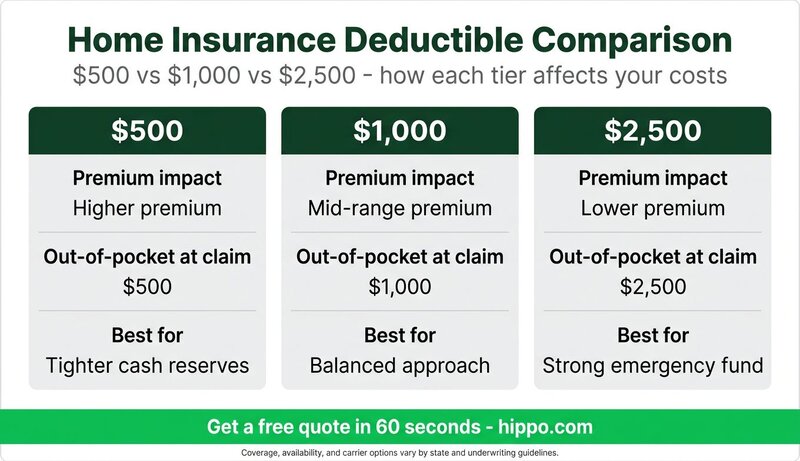
$500: A lower out-of-pocket cost after a claim, but a higher monthly or annual premium. Good for tighter cash reserves.
$1,000: A common middle-ground choice with a balanced premium and claim-time cost for many homeowners.
$2,500: A lower premium, but a higher claim-time cost. Suits homeowners with strong savings who want to reduce monthly spending.
The best deductible is one you can pay tomorrow
The single most practical test for choosing your deductible: could you write a check for that amount today without going into debt or financial stress? If yes, that deductible may be manageable. If no, you may need to consider a lower tier - even if the premium is higher. A deductible you can’t pay is a coverage gap in disguise.
$500 vs $1,000 vs $2,500: which deductible should you choose?
The three tiers most commonly offered in standard homeowners policies each have a distinct trade-off. Here is how they compare:
Deductible | Premium Impact | Best For |
|---|---|---|
$500 | Higher premium | Tighter cash reserves or first-time homeowners. |
$1,000 | Mid-range premium | Balanced approach with some emergency savings. |
$2,500 | Lower premium | Strong emergency fund, low claim likelihood. |
How to pick the right deductible in 5 steps
Step 1 - Check what you could pay out of pocket (without stress)
Look at your emergency fund. A common guideline is to keep three to six months of expenses in accessible savings. Choose a deductible no higher than what you could pull from that fund without depleting it entirely.
Step 2 - Estimate premium savings and break-even
If moving from a $500 to a $1,000 deductible saves you $80 per year in premiums but increases your out-of-pocket by $500 at claim time, you need roughly six claim-free years to break even. This math varies widely, but the concept helps you weigh the trade-off.
Step 3 - Consider your claim likelihood (but don’t overthink it)
Factors like home age, roof condition, location, and weather exposure can affect claim likelihood. An older roof in a hail-prone area may see claims more frequently than a newer build in a low-risk region. That said, insurance exists precisely because losses are unpredictable.
Step 4 - Watch for separate deductibles (wind/hail, hurricane, named storm)
In coastal and storm-prone regions, your policy may include a separate percentage deductible for wind, hail, hurricanes, or named storms. These are calculated on your Coverage A dwelling limit, not the claim amount, and can be significantly higher than a standard flat deductible. Always check your declarations page for any peril-specific deductibles.
Step 5 - Don’t choose a deductible that changes how you’d file a claim
A deductible that’s so high you’d skip legitimate claims defeats the purpose of having insurance. If you set a $2,500 deductible but every claim runs $2,600-$3,000, you’re effectively uninsured for those losses. Your deductible should leave real value in your policy for the claims that are most likely to occur.
Deductible vs coverage limits: what matters more?
Your deductible handles the first dollars of a covered claim. Your coverage limit handles the large ones. Both matter, but they work differently. A $500 deductible with inadequate coverage limits can leave you dramatically underinsured after a major loss - paying only $500 upfront but facing hundreds of thousands in uncovered rebuild costs.
Make sure your dwelling coverage limit reflects your home’s current rebuild cost before obsessing over deductible tier. Both need attention, but a coverage gap is typically more costly than a deductible that’s $500 higher than ideal.
Frequently asked questions
Is a $1,000 deductible good for home insurance?
A $1,000 deductible is a common middle-ground choice. It typically lowers your premium compared with a $500 deductible while remaining manageable for homeowners with modest savings. Whether it is right for you depends on your financial cushion and the premium savings your specific carrier offers.
Is a $2,500 deductible too high?
Not necessarily, but it depends on your savings. If you have a well-funded emergency account and the premium savings are meaningful, $2,500 may be a reasonable choice. If paying $2,500 after a loss would create financial hardship, it is likely too high for your situation.
Can you change your deductible later?
In most cases yes, typically at renewal. Some carriers may allow mid-term changes via an endorsement, though this varies by insurer and state. If your financial situation changes significantly, reviewing your deductible at renewal is a good habit.
Do you pay the deductible for every claim?
Typically yes, on a per-claim basis for dwelling and personal property claims. Liability and medical payments claims generally do not require a deductible. Some policies may have different structures, so review your policy wording to confirm.
Do deductibles apply to roof damage?
Yes, your standard deductible applies to roof damage from covered perils. However, if your policy includes a separate wind and hail deductible, that amount may apply instead for storm-related roof damage, and it may be significantly higher. Check your declarations page before filing.
How Hippo can help you compare deductible options
When you get a homeowners quote, you can typically view how your premium changes at different deductible tiers. Hippo’s quoting process works across a network of carriers and lets you see those trade-offs side by side. Eligible homes may also qualify for smart home discounts. Quotes take about 60 seconds to start at hippo.com.
The bottom line
A good home insurance deductible is one you can pay without stress after a covered loss. For many homeowners, $1,000 strikes a practical balance between premium cost and manageable out-of-pocket exposure. But $500 or $2,500 can both be smart choices depending on your savings and risk profile. Compare deductible tiers in a real quote to see how the numbers play out for your home and location.
Get a homeowners insurance quote and compare deductible options at hippo.com.
Coverage, availability, and carrier options vary by state and underwriting guidelines.